Search Results for: feed

Building more complex commands using Raspberry Pi terminal

Probably this would be unwise to go through a long list of available Unix commands. It is quite long, and there is no reason to point out each of them here. You can take a look at some basic ones in the following list. It is more important to learn how to use them and get the desired result by building more complex commands. Commands can also be combined into a single line using piping. In this case, the output of one command becomes the input of the next one, and so on. Let’s go with a few examples. We all know that Raspberry Pi comes with Python installed. So we should expect to find lots of .py files here: sudo find / -name *.py this throws us a large list of file names: Finding and displaying files that way is useless. Viewing is even more painful. Let’s say we simply want to count all .py files. For this, we use the same command, but instead of throwing the list to the terminal, we feed it to another command that does the counting of lines (we get every file in a new line):

Continue reading

Getting used to Raspberry Pi

raspberry pi model b

It’s been quite some time since my Raspberry Pi Model B arrived. All I’ve done is tried to run several things, blink GPIO with examples found on the Internet, set up a desktop computer for my daughter with TuxPaint. I never was a big fan of Linux; on the desktop computer, I always use Windows for my daily tasks. With cheap single-board computers like Raspberry Pi, people looked at Linux from a different perspective. We can notice an increased interest in Linux, how to do this, and this. Who works with Linux long time? It is just another computer where they can work with it and make cool things right away. But for us like me, it’s a good chance to get to know Linux better and learn a few tricks.

Continue reading

How to drive servo motor control with AVR microcontroller

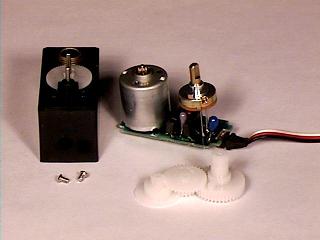
Servo motors are so-called “closed feedback” systems. This means that the motor comes with a control circuit inside, which senses if the motor mechanism is in the desired position. If not, it continuously corrects an error until the motor reaches the angle. Servo motors are widely used in robotics, remote-controlled planes, vehicles, and many other industrial machines. They come in many shapes and sizes, but they all operate in almost the same way. Usually, servo motors are controlled by a computer, microcontroller, or even a simple timer circuit. How Servo Motor Control Works Usually, servo motors are put in the plastic box, but inside there is a whole system: motor itself, gears, and motor driving and control circuit. The gears reduce motor speed but increase torque. As we mentioned, servos work with a closed feedback loop when the potentiometer is connected to a mechanical shaft and senses the angle of turn. The potentiometer voltage directly indicates the grade of twist. The potentiometer signal goes to a digital controller of the motor, which powers the motor until the potentiometer reaches the desired angle, then the logic circuit shuts the motor.

Continue reading

Machine vision faster than human eye

Machine vision is more compact when compared with the other equipment. These equipment types are extensively utilized to develop more organized manufacturing operations carried out at the shop floor without any confusion. The machine vision system is a combination of imaging and controlling hardware that can influence the more complicated equipment utilized in manufacturing like robot-arms. The robot arms are to be calibrated concerning the positional deviation allowed in a particular workstation. Hence precise monitoring of the working of such equipment is necessary. The inspection process greatly relies on utilizing the machine vision system to mobilize better results in the overall production process. Inspection is considered to the shop floor’s life and can greatly decide the operation’s outcome in many ways. Inspecting relatively tiny and but the machine vision systems carry out active components like IC chips. They are supplied with imaging equipment like the camera to focus the change in the position of the component that is to be measured. This setup is employed to monitor the assembly lines carrying the supply of the raw material or finished goods traveling at a constant speed towards the successive workstations.

Continue reading

Human Power Generators

The developments in the field of science and technology have cashed heavily over the existing sources of power. This has slowly depleted the non-renewable sources of power, such as power from the burning of fossil fuels like petrol and diesel. Researchers and scientists have also scoped that if existing fossil fuels exist, this may degrade fossil fuel sources and leave future generations’ survival under the spot of bother. This, in turn, has churned scientists and professionals’ minds in the field of science to strategize new ways of developing power. This made scientists postulate the significance of renewable sources. Researches were carried out worldwide to mobilize the thoughts of using renewable sources in daily life to substitute the existing sources of power. This laid to develop human power generators that help to produce power by establishing contacts between work done by a human being and simple manifestation of awe-inspiring thoughts to transform as generators. This has provoked several manufacturers to materialize human power technology into simple gadgets to make people enjoy the fruits of advancements in science and technology. Physiological features Certain physiological features establish suitable use of scientific advancements. Human power generators have certainly complacent internal configuration with highly durable…

Continue reading

Future Robots Are Ready To Replace Human Beings

Robots are one of the most significant milestones in the field of science and technology. They are ready to replace human beings. They can even be a friend to you or a companion when you need someone. Japan is one of the birthplaces of most robots. In Japan, people are trying to design a robot that can even show emotional reactions like fear, anger, sadness, disgust, happiness, and even surprise. When you say a word like ‘war’ to the robot, he immediately shows the emotion of fear, and when you say love, the robot smiles with its pink lips. What more do you expect an assembled metal and wires to do? The future of robots is extensive and more sophisticated uses. Researches are going on to bring about a robot to monitor farming. The robot would know the need of the plants and act based on that. When a plant needs water, the robot will water them, or if the plant needs nutrients, it would be supplied by the robot. So the robot is not restricted to the computer field and heavy machinery industries, motor industries, and paddy fields.

Continue reading

Topobo – robot with kinetic memory

Robot toys are trendy among children these days. Especially DIY robot kits are getting more popular as these kits stimulate imagination and creativity. Topobo kit is becoming a most playful robot kit with kinetic memory where the assembled robot can memorize its motion and play it back. It is possible to teach robot various motions like animal walk, dance by simply guiding it. Three researchers of MIT Media Lab developed Topobo. This is not a new toy, but since 2003 it was used for various exhibits, and only a few lucky could try this toy. Now, this kit is widely accessible.

Continue reading

Overview of Programmable Logic Devices

These are devices that are used in electronic circuits to make reconfiguration of the same possible. The logical gates that are normally used perform a fixed function; however, the Programmable Logic Devices (PLD) do not perform any predefined task when manufactured and need to be programmed before they can be used.Before the introduction of PLDs, ROM (Read Only Memories) was used. EPROM could be programmed using any standard hardware for that device and hence, did not require any other peripheral hardware. Another advantage of ROMs is that a particular binary code stored in it could be obtained on any of the n output lines available. Thus, they can be programmed in any way one wishes to. However, ROMs have some disadvantages when they are used as PLDs. They do not produce the outputs as quickly as other devices; they are not very dependable as far as asynchronous inputs are concerned; they require more power, etc. The first PLD was the programmable logic array developed from ROAM (Read-Only Associative Memory) by modification of one of its metal layers and 17 inputs and 18 outputs.

Continue reading