Five industries which use printed circuit boards
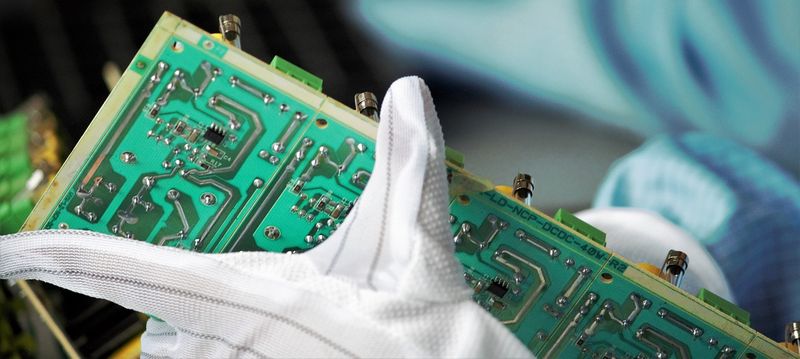
Printed circuit boards are the most essential components in all electronic appliances and products. Most of use these boards every day without even realizing what they are. If you ever open up your broken remote, you will see a circuit board which is infused with a lot of wires; it is called the printed circuit board. They are an integral part of electronic devices and are used in our everyday lives. They have many lines on them and continue to be infused in all electronic devices until this day. These boards are responsible for connecting the product to the wires via copper sheet. They are commonly used by the following industries:

Continue reading

How to Find a Reliable Flexible Circuit Board Manufacturer | WELLPCB

flexible circuit board

Are you in the process of designing your following product? We are sure you want to get every detail right, which is why you can benefit from a flexible PCB. These boards are bendy and capable of accommodating any design. However, you should ensure to pick a reliable flexible printed circuit board manufacturer, and that is not always an easy task. Take a look at this simple but informative guide on flexible PCBs, and learn how to pick the right company to order from today. 1. What Is a Flexible Circuit Board? A flexible circuit board is a PCB that has been specially designed to be flexible. Flexibility is the essential feature of these boards, and it is the reason why they are becoming so popular. Flex PCBs have a wide application field, including but not limited to: You can use them wherever you need adaptability from the circuit board. If you realize that you require a bending circuit during the assembly process, flex PCBs will be the ideal solution.

Continue reading

Choosing best PCB manufacturer for your needs

Many PCB manufacturers offer good quality PCBs for a low price. Anyway, there may be lots of small things that may lead to a few inconveniences if your choice isn’t the best. Of course, the primary source to check out is the Internet. Customer feedback may be a good starting point to evaluate the PCB manufacturing process of the chosen vendor. Other sources worth checking are the social media, colleague recommendations, or other influences. Sometimes there is nothing wrong with trying any manufacturer with some small batch and evaluating PCB manufacturing process and building quality by yourself. There may be a different experiences for different people, and what is bad for one may be suitable for others. Evaluating the quality of delivered PCB If you decided to try a new PCB manufacturer, there are some key points that you may want to check when boards are received. Most of them are PCB quality checks. You may go through several aspects, such as: These are small and basic things that may influence the choice of PCB manufacturer. The PCB quality is the key to a successful build of the electronic device. Design your PCB while keeping an eye on manufacturer requirements…

Continue reading

Printed Circuit Board (PCB) Technologies

The term circuit technology usually refers to the various techniques used in the manufacture of electrical circuits. A large number of devices that are used today make use of printed circuit boards (PCBs). These devices provide mechanical support for the various components present within the given device and the components’ electrical connections. The electrical connections present on the PCB are made out of copper sheets laminated on a non-conducting material. Initially, a large copper sheet is laminated on the board, and then the sections that are not required are removed. Various techniques are used for the removal of unwanted copper. Some of them are: Silk Screen Printing: In this technique, an etching-resistant ink is applied to those required areas, and the remaining part is etched off. Photoengraving: Here, a photomask of the circuit required is prepared using the desired software, and then it is applied to the blank PCB. After this, the portions that are not required are etched off. PCB Milling: In this technique, a mechanical milling system that can work on 2 or 3 dimensions is used to remove the copper. The milling system is controlled by software. In some other techniques, only the required copper is added…

Continue reading

Eagle CAD PCB footprints for audio processors TDA7313 and TDA7315

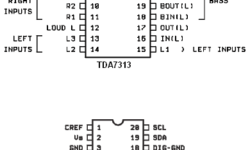
TDA7313 and TDA7315 are digital controlled audio processors used in applications where digital control of audio is needed. TDA7313 and TDA7315 are pretty the same just TDA7313 is more complex by having 3 stereo input channels and two outputs (front and rare). Both chips have volume control (step=1.25dB), tone (bass and treble) balance, independent faders for each output processor. Also, there is loudness functionality. TDA7313 and TDA7315 have low distortion and low noise, making them ideal for quality audio applications for car audio and Hi-FI systems. MCU can control both chips via the I2C(TWI) protocol. This makes it easy to interface microcontrollers with additional features like LCD, buttons. Or control directly from PC using RS232 or another interface. Both chips can be found in DIP or SO packages. Here are Eagle libraries of both digital audio processors that I have made. tda7315.zip(2kB) tda7313.zip(2kB) I have intent to make a control board with TDA7315 with LCD and button control using an Atmega8 microcontroller.

Continue reading

PCB construction methods for embedded controllers

The most common method is of constructing embedded controller systems is a Printed Circuit Board (PCB). All electronics know that simple PCB is constructed of insulating material like epoxy impregnated glass cloth with a thin copper sheet(s) on one or both sides. There are many conflicts about requirements on how to design interconnection patterns of PCB. But the main purpose for all is to make PCB reliable, effective and producible. If the circuit operates at a low speed, requirements are not as strict as for high-frequency devices where the parasitic effect cannot be ignored. Each PCB stray has its own resistance, capacitance, and inductance. These are the main effect that distorts the signals.

Continue reading

Desoldering Atmega128 using a lighter

I heard about this method and decided to try it with my board. I needed to replace the Atmega128 chip but didn’t have hot air solder for desoldering IC. I tried this weird desoldering technique, and I can say that I was satisfied. Tracks and other parts weren’t damaged. The Atmega128 board is working again as before.

Continue reading

PCB Exposure using UV light LED box

I came across this interesting project. The guy decided to make a UV PCB exposure box made of UV light LEDs. The main reason why he used LED was the power dissipation and compactness. Assuming that one UV tube would take about 6W while one UV LED would take about (20mAx3.2V=64mW). Most of that energy UV tubes dissipate as heat energy. So he took: 54 x UV LEDs of 400nm (6000 – 7000 mcd) – 100 units in Ebay costed 12€;18 x 68ohms resistors 1/4W – 0,36 €;1 connector – 0.50€;1 electrolytic condenser of 2200uF – 30v;1 Eurocard Plate 100×160 about 5 € ;

Continue reading

Place electronics parts correctly on PCB

Let’s go through a few examples of how to place electronic parts correctly on the PCB board. SMD electronic parts, especially if the lead pitch is above 1 mm, then placement of leads has to be symmetrical on copper planes: If IC has a smaller lead pitch like 0.5 – 0.8mm, positioning by hand becomes harder. Sometimes it is recommended to use special glue to fix SMD parts before soldering. DIP electronic parts must be soldered as close to the PCB board as possible to make them stand stable and avoid heat resistance.

Continue reading

Generic PCB design guidelines

How repeatedly make good PCB? Many hobbyists face this issue every time they are prototyping their ideas. Designing the PCB layout (it doesn’t matter it is a through-hole or surface mount) may be a tricky task, especially when dealing with dimensions like 0.2mm tracks or 0.5mm surface-mount pitches. A laser printer, plotting, or other similar transfer technologies can’t deal with such dimensions. After I have tried the photographic method of PCB artwork transfer, I don’t even want to touch the Iron and laser printer. Using photosensitive laminate and single transparent media, I can repeatedly make any number of PCBs. The benefits of using photographic methods are as follows:

Continue reading