




Smart traffic systems begin with a physical event. A vehicle crosses an inductive loop, disturbs a magnetic field, passes a camera, or triggers an environmental sensor. The sensor converts that event into a timestamped measurement. Firmware then creates useful information, such as “vehicle present,” a traffic count, or an estimated pollution level.
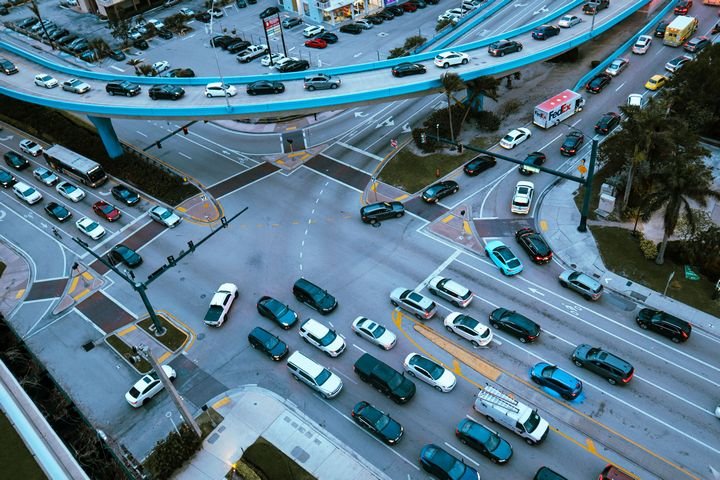
An IoT gateway transfers this information to a central platform for monitoring and analysis. However, connected sensing alone does not reduce congestion. Improvement depends on the complete chain: measurement, transport, interpretation, command validation, field execution, and confirmation of the result.
Choosing the Right Traffic Sensors
No sensor is universally best. Each technology measures something different and has its own installation and maintenance requirements.
Inductive loops detect vehicles through electromagnetic changes but require pavement cuts and wiring. Magnetic sensors can be easier to deploy, although some struggle to identify stationary vehicles. Microwave radar measures speed, range, or presence, but certain designs may not detect stopped traffic.
Lidar creates vehicle profiles from distance measurements, but occlusion and alignment can affect performance. Cameras and ANPR systems support classification and plate recognition, yet glare, vibration, dirty lenses, and privacy requirements matter. Acoustic and ultrasonic sensors may be influenced by noise, temperature, and installation geometry.
Environmental sensors introduce other challenges. Optical PM2.5 sensors can respond to humidity or fouling, while electrochemical gas sensors require calibration for temperature, ageing, and cross-sensitivity. The right choice depends on the measurement target, road geometry, weather, maintenance access, and reference-testing method.
Designing the Complete Sensor Node
A roadside node combines sensing, processing, memory, communications, and power. Battery estimates should include the entire operating cycle—not only processor sleep and nominal transmissions. Sensor warm-up, sampling, local analysis, storage writes, network association, retries, acknowledgements, clock synchronization, and recovery after power loss all consume energy.
The design should define how much data is stored during an outage, which records are removed first, and how buffered events are replayed. Roadside equipment must also tolerate weather, vibration, electrical interference, and physical exposure.
Connectivity and Edge Processing
Ethernet, cellular, LoRaWAN, NB-IoT, and LTE-M provide access paths, while MQTT, Modbus, and NTCIP define messaging patterns, application exchanges, or controller-facing objects. These technologies should not be compared as if they perform the same function.
Connectivity decisions should consider coverage, bidirectional link quality, payload size, reporting frequency, retries, outage handling, latency, and energy per delivered event. Low-power settings that save battery may delay downlink commands.
Edge processing can convert raw signals into compact events before sending them centrally. This reduces bandwidth use but adds responsibilities. Events should include a source timestamp, sequence number, device identity, rule version, quality flags, and diagnostic context. Stable identifiers are important because some delivery methods produce duplicates.
From Central Visibility to Safe Control
A central platform can monitor device health, visualize conditions, generate alerts, recommend timing changes, and supervise approved commands. Yet visibility is not control authority. Local controllers and cabinet safety systems remain the final safety boundary.
A reliable command path records the request, verifies permission, sends the instruction through the controller interface, reads the controller state, and compares the requested action with actual field operation. If communications, software, detectors, or processors fail, controllers should return to a defined local or non-adaptive mode while recording the alarm.
The practical sequence is simple: observe before recommending, recommend before supervising, and supervise before automating. Each stage needs clear acceptance tests and a verified return path.
Where Iotellect Fits
The Iotellect traffic management solution provides a low-code environment for connecting traffic sensors, cameras, signals, controllers, ANPR systems, parking infrastructure, and vehicle-to-infrastructure devices. It supports centralized dashboards, alerts, analytics, integrations, and operational workflows.
Successful deployment still requires site-specific validation. Cities should test sensor accuracy, network latency, outage recovery, controller compatibility, fallback behavior, cybersecurity controls, and maintenance procedures under real operating conditions. Smart traffic outcomes come not from collecting more data, but from creating a measurable, reliable, and safely controlled path from roadside events to verified action.